
Skip to content

The average lease car spends 90% of the time standing still.

The costs and the taxable benefit keep running. Klicq puts idle cars back on the road in four ways, each one fully tax-compliant. Everyone is better off.

Do you manage the fleet? This is how Klicq takes work off your hands
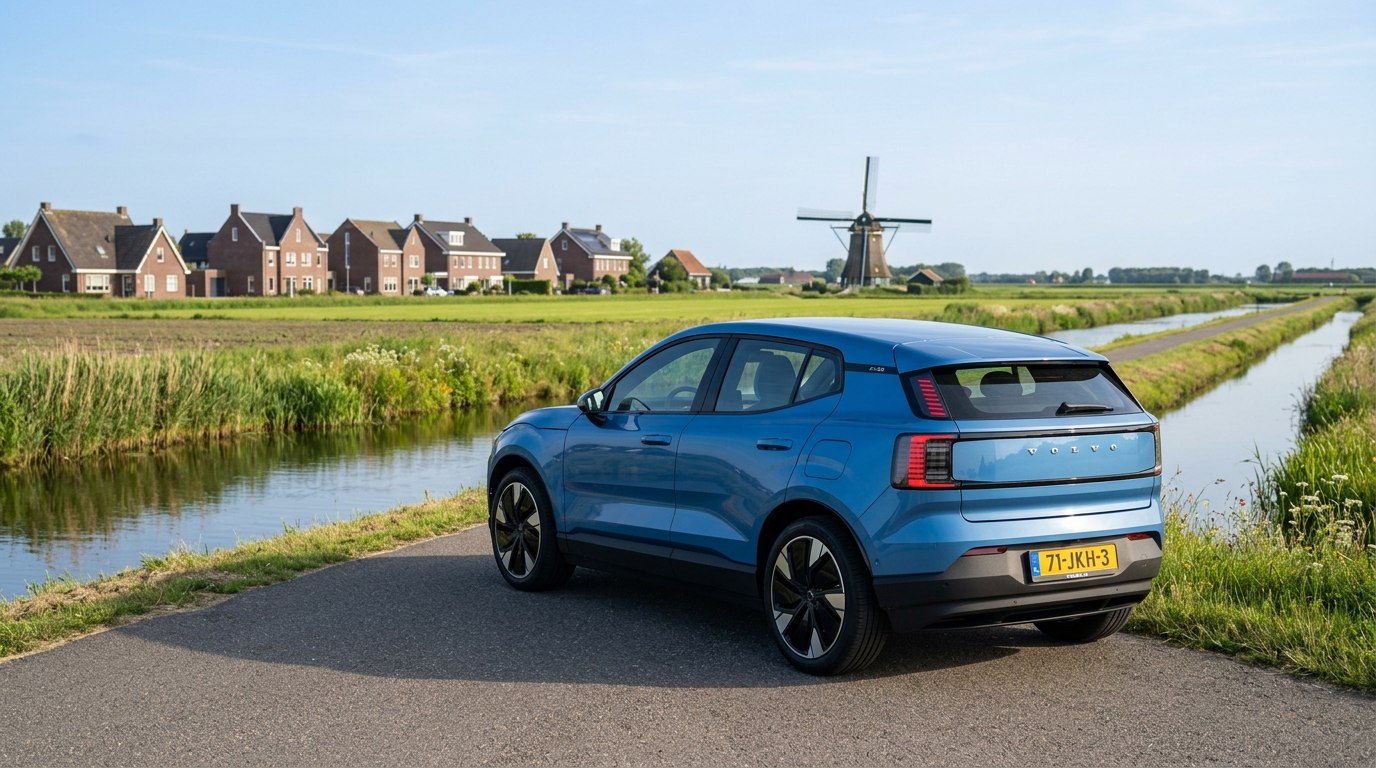
Bas's Volvo EX30, registration 71-JKH-3

Volvo EX30

Bas's lease car

71-JKH-3
  1. Mon21Bas drives
  2. Tue22idle
  3. Wed23Bas drives
  4. Thu24idle
  5. Fri25idle
  6. Sat26idle
  7. Sun27idle
A week in September, without sharing. Even on the days Bas drives, the car is parked for most of the day.

Four solutions, from everyday practice.

Private lending, swapping, the pool car and business lending. Each solution removes its own share of idle time, and none of the four adds any admin for you.

Bas, a lease driver who shares his Volvo EX30 via Klicq
Baslease driver, shares his Volvo EX30

3 weeks' holiday. The car earns while Bas surfs.

Bas goes to Portugal, sets his EX30 to “available” in the Klicq app and parks it at the office. Three colleagues use the car while he is away: 1,101 km of private driving in 8 days. No coordination, no admin.

net taxable benefit this month for Bas
−€116
all-in cost for colleagues
+€229*
net revenue for the employer
+€64*
Private lending
A colleague borrows the car for private use on days the lease driver does not need it.
Tax
The taxable benefit for those days shifts automatically to whoever drove: a minus line for Bas, a plus line for his colleagues.
Who wins
Bas pays less taxable benefit. His colleagues have a car when they need one. The employer sees a car on the road that it pays for anyway.
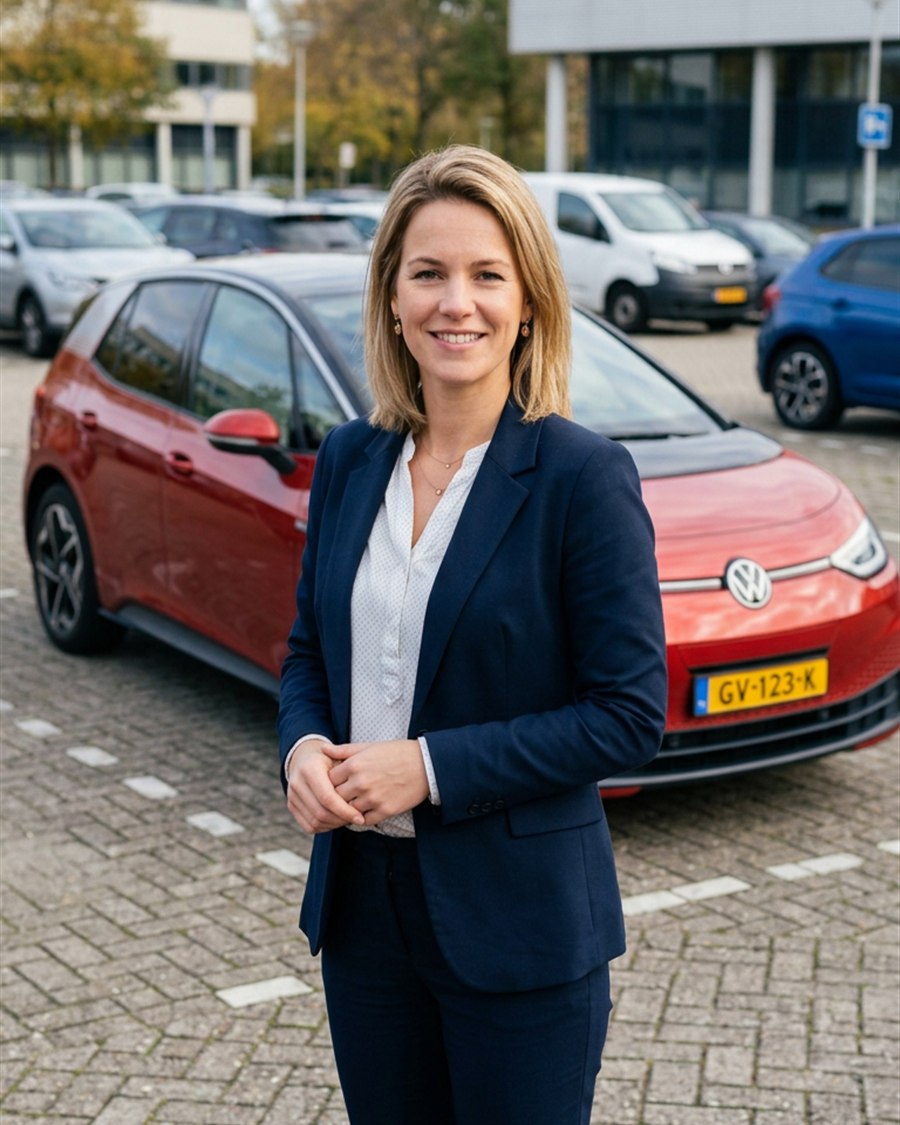
Mireille, a lease driver who deliberately chose a compact ID.3
Mireillelease driver, deliberately chose the ID.3

Compact for the city. Swap for the rare long trip.

Mireille nearly always drives within Utrecht. She used to choose a bigger car, “just in case”. Now she drives a compact ID.3 and swaps with a colleague a few times a year when she does need a big car. Lower costs and lower consumption, without giving up flexibility.

lease costs per year
−€1.420
taxable benefit per year
−€612
less energy per year
−550 kWh
Swapping
Two lease drivers swap cars for an agreed period. A lease driver does not rent, they swap.
Tax
The taxable benefit follows the car you drive during that period.
Who wins
Mireille drives the car that suits her week, and now and then the car that suits that one trip. The employer pays for a smaller car and does not have to hire one for that trip.
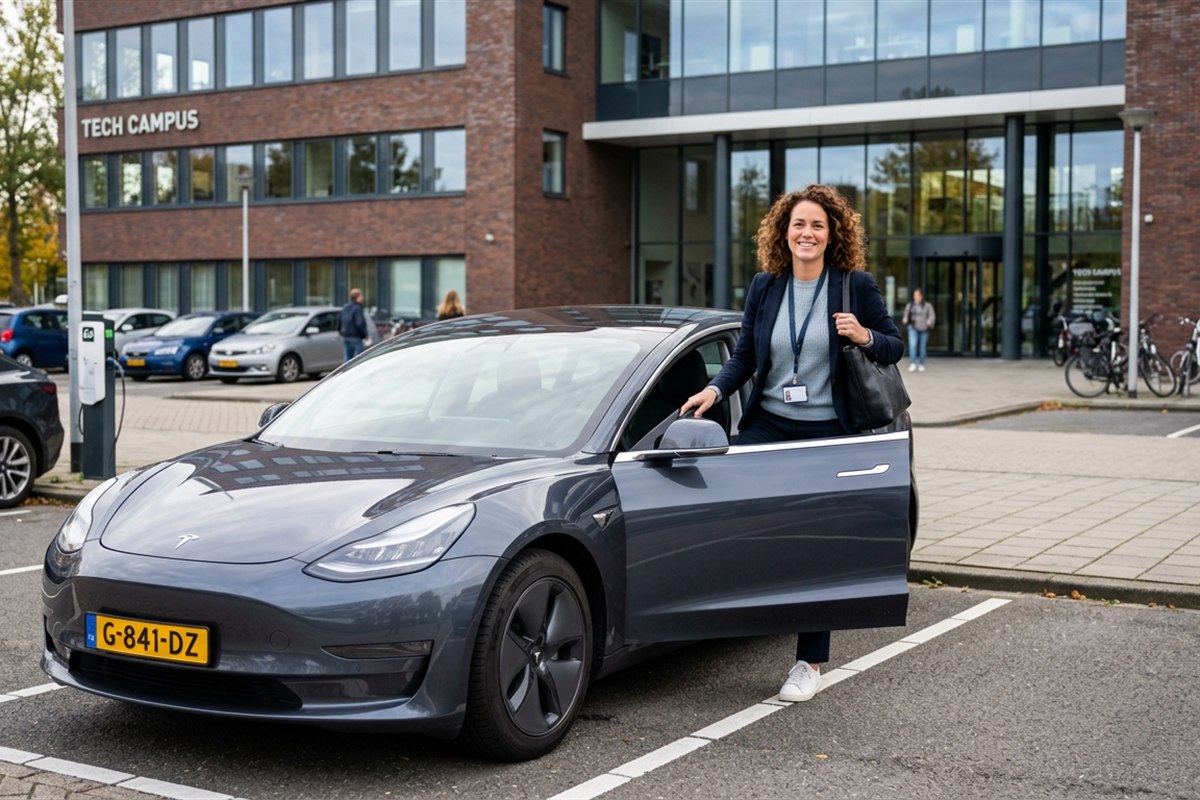
A colleague steps out of the pool car, a Tesla Model 3, in the office car park
The pool carat the office, for colleagues without a car

No more double bookings. No more idle days.

The pool car at the office often stood idle. Sometimes it was double-booked, and afterwards nobody knew exactly who had driven it or where the costs should go. Now colleagues book it in the app, for a client visit or a meeting. Every trip is logged, and the costs go to the right cost centre.

utilisation rate
82%
compared with two cars, per year
−€7.800
admin per trip
0 min
The pool car
The car is at the office for colleagues without a car. Lease drivers do not use it.
Tax
Business use only, so no taxable benefit and no line on the payslip. Every trip is in the trip log.
Who wins
The colleague has a car for a client visit. The fleet manager sees the utilisation without Excel. The employer gets more out of the same car.
Sanne, a colleague without a lease car, steps out of a colleague's lease car with a cup of coffee
Sannecolleague without a lease car, with a client appointment

Client visit? Take the car that is already at the office.

Sanne has no lease car and needs to visit a client. She used to take her own car and claim the mileage afterwards. Now she sees in the app which lease car is at the office that day, and takes it. That means far fewer business trips in private cars.

  • No claim afterwards
  • No hassle with booking
  • Trip logged
Business lending
If a lease car stands idle during the day, a colleague uses it for a business trip.
Tax
A business trip creates no taxable benefit and shifts none either. The trip is recorded in the trip log.
Who wins
It costs the lease driver nothing. Sanne has nothing to claim. The employer has fewer mileage claims and hire cars.

Worked examples. Amounts marked * depend on your sharing policy.

Well meant. Not tax-compliant.

Colleagues help each other, and company cars have been shared for years. That is practical, but rarely recorded. The Dutch Tax Administration does not assess intentions, only what can be proven.

  • The pool car taken home

    If it is parked outside their home in the evening, the colleague has it at their disposal outside working hours, including for private use.

  • The lease car lent out for a weekend

    The colleague drives it privately, but the lease driver's taxable benefit does not cover them.

  • A gap in the trip log

    If it is filled in afterwards, it has no evidential value: the Tax Administration checks it against fuel receipts and MOT (APK) readings.

Not a paper risk: the Tax Administration actively checks this. If the evidence is missing, an additional assessment follows going back up to five years, with a fine and interest. Per pool car this can run into tens of thousands of euros.

Sharing is allowed, via Klicq. Every shared use is recorded: who had the car, from when to when, and for what.

For the fleet manager: control, without extra work.

Whoever manages the fleet keeps sharing under control. Klicq records every shared use; you see the whole fleet in one overview and only step in for an exception.

  • Sharing rate and utilisation per month and per location.
  • Lease and pool cars in one dashboard, and for every shared trip, who drove.
  • You only step in for an exception: if an odometer reading does not match, the platform points out the gap.
  • No Excel: booking, logging and settling run automatically.
How it works for fleet management
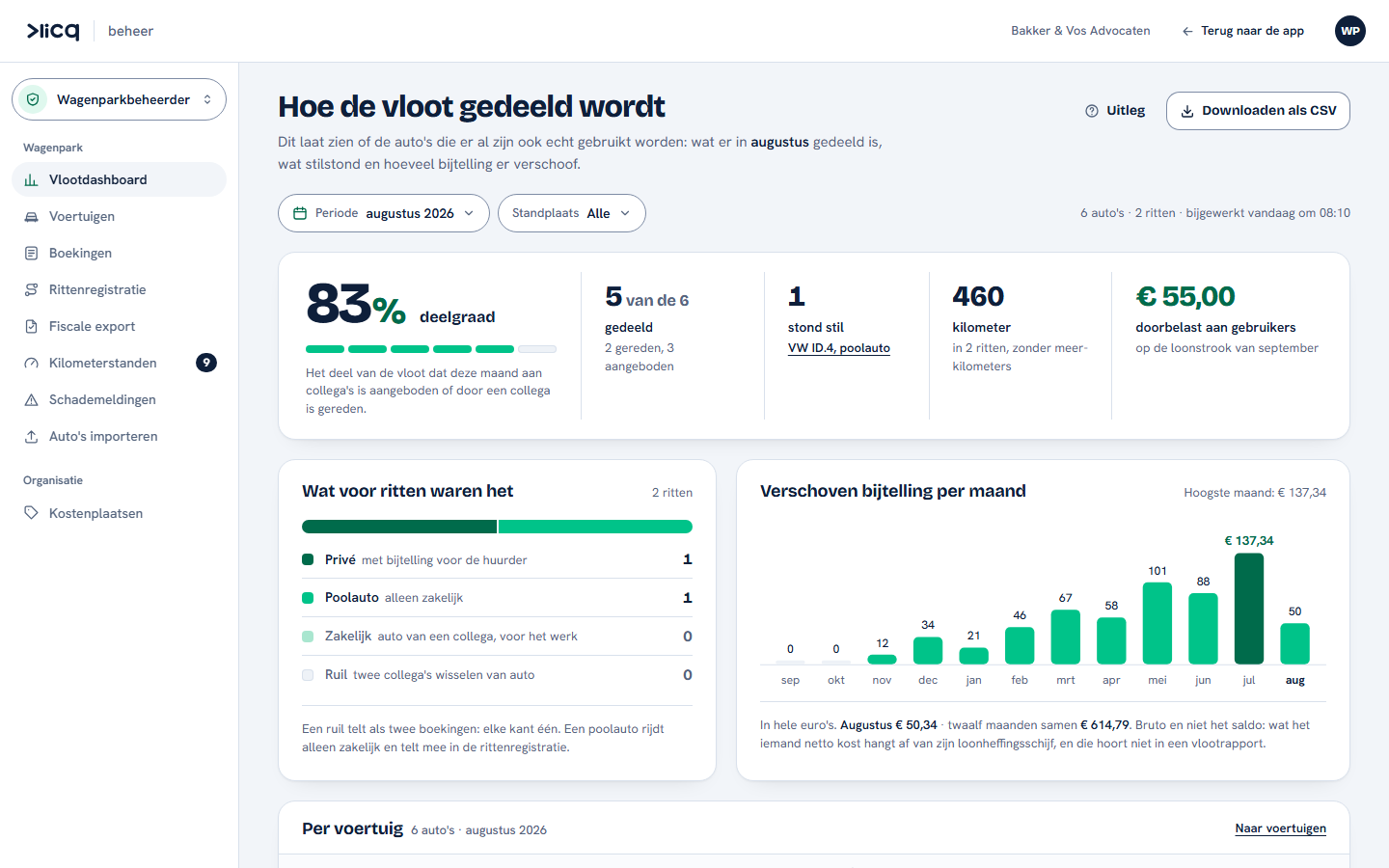
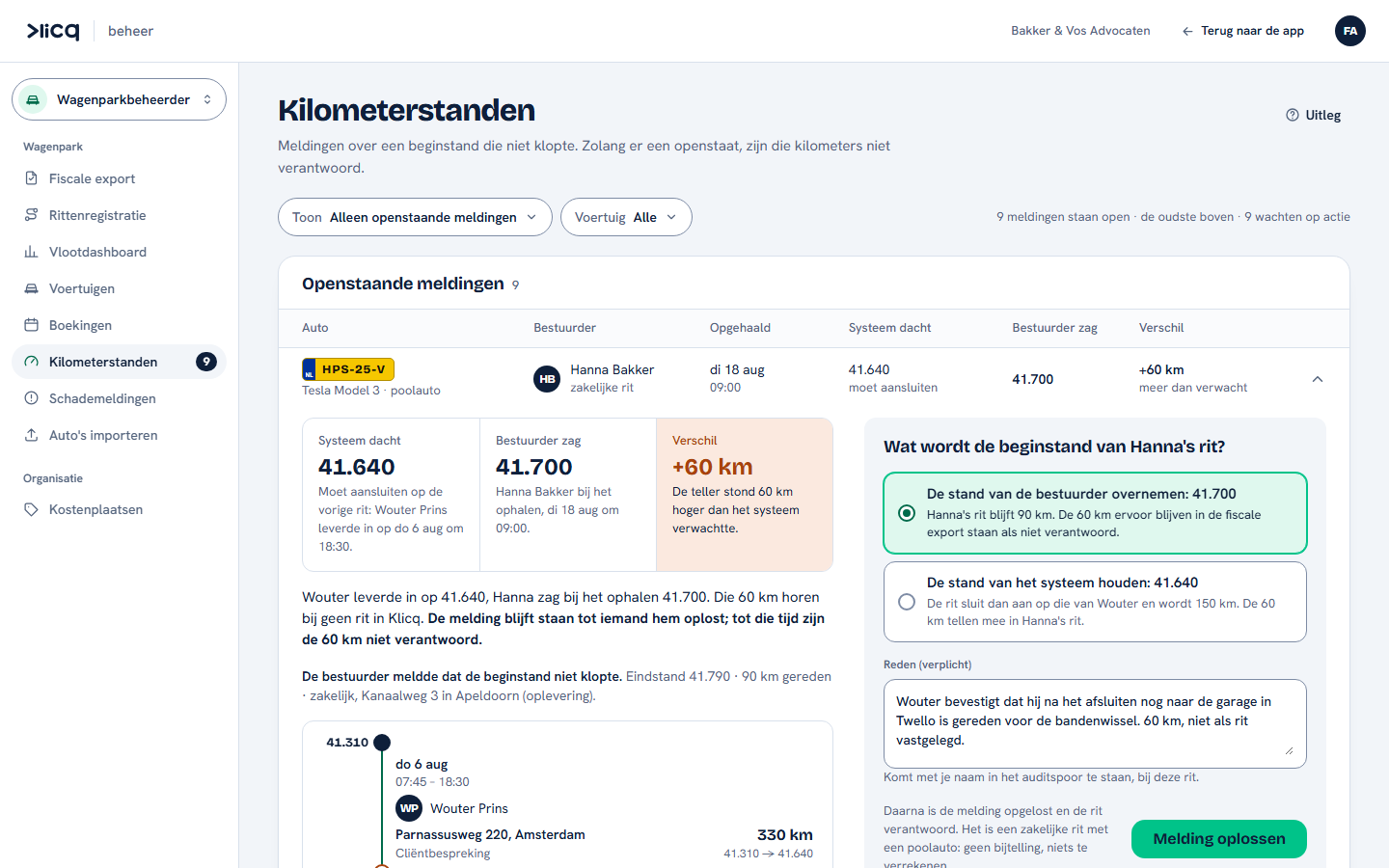
The Klicq fleet dashboard: 83% sharing rate in August, five of the six cars shared, one stood idle, the types of trips and the shifted taxable benefit per month Odometer readings in Klicq: an open alert for the pool car, the system expected 41,640, the driver saw 41,700, a difference of 60 km
Fleet dashboard and odometer readings · how it looks in the platform, with sample data. An alert is open under odometer readings: the pool car's starting reading is 60 km out, and the alert stays open until someone resolves it.

Tax done right, all the way to the payslip.

A private trip as an example: on Tuesday 8 September, Hanna borrows Saskia's Polestar 2. The taxable benefit for that day ends up correctly with both of them, without anyone doing the maths.

Hanna Bakkercolleague without a lease car, she drove

This is how it appears on her payslip

Taxable benefit, car via Klicq · plus line€33.56

Gross, on her October payslip. This amount is added to her salary.

What she notices net

€16.61

net, in October · calculated at tax band 3 · personal contribution €0.00

Image of a Polestar 2, not of this car

Polestar 2

HTP-98-D

Tue 8 Sep · private trip

the taxable benefit for this day, from Saskia to Hanna

Saskia van Dijklease driver, the Polestar is hers

This is how it appears on her payslip

Taxable benefit, car via Klicq · minus line−€33.56

Gross, for Tuesday 8 September. This day is not added to her salary.

What she notices net

€16.61

less tax withheld, in October · calculated at tax band 3

What you do not have to do for it.

From click to journal entry, the platform does the work. Your payroll team processes the lines; nobody recalculates anything.

Keeping track of shared trips and mileage
Every shared use is recorded, per person, with business and private use kept apart.
Calculating the taxable benefit per day
Klicq calculates the taxable benefit and the personal contribution, to the day.
Passing corrections on to payroll
Klicq supplies the changes: a minus line for the lease driver, a plus line for the colleague. Processed by hand or through an integration.
Proving that the mileage adds up
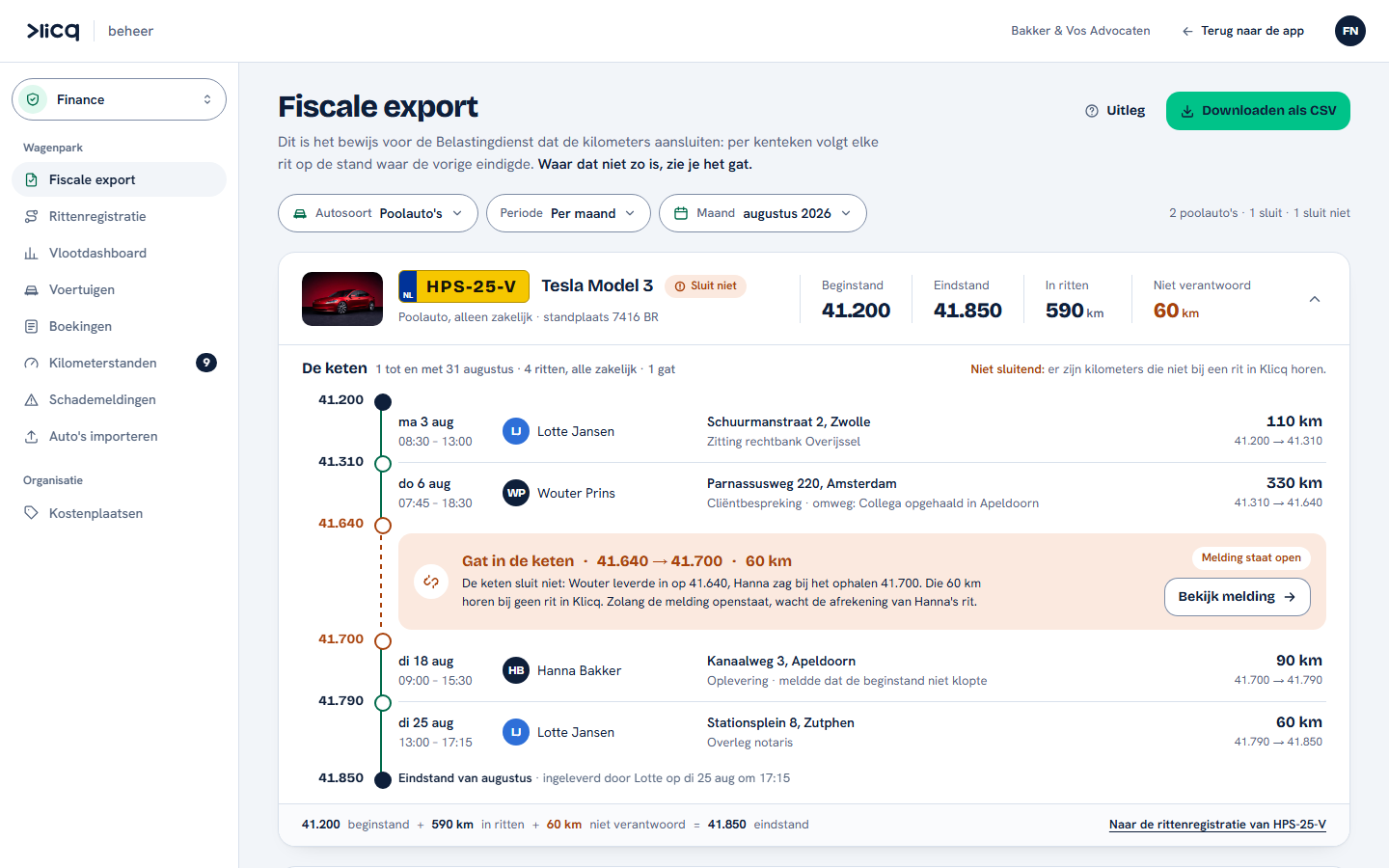
The tax export shows, per registration number, that every trip continues from the previous one. Where it does not, the platform points out the gap.
The tax export: per registration number, the chain of odometer readings, trip by trip, with a 60-kilometre gap that the platform flags itself
Tax export · the Finance screen, here a pool car in August, with sample data. This is how it looks; where the chain does not close, the platform points out the gap.

Sharing only works if everyone gains.

The fleet manager, the employer, the lease driver, the colleague who borrows, and the leasing company.

  • Fleet managers

    Less idle time: the same fleet, more mobility.

    One dashboard for lease and pool cars: higher utilisation and insight, while the platform does the rules.

    For fleet management
    • Volvo EX3071-JKH-3With a colleague
    • Polestar 2HTP-98-DAvailable
    • Tesla Model 3 · pool carG-841-DZBusiness only
  • Employers

    Less idle time: the cars you already pay for do more work.

    Lower fleet costs, an attractive employment benefit and tax certainty, without extra admin for HR or Finance.

    For employers

    This is how it appears on the payslip

    Taxable benefit, car via Klicq · plus line€57.01

    Gross line, supplied by Klicq. Your payroll team processes it; nobody recalculates anything.

  • Employees

    Less idle time: a lower taxable benefit for the lease driver, a car for the colleague without one.

    Lease drivers lower their taxable benefit by sharing. Colleagues without a lease car borrow one, for business and private use.

    For employees

    €16.61

    a day in a colleague's Polestar 2, on the October payslip

  • Leasing companies

    Less idle time at your client: their cars are used better, within the contract already in place.

    A sharing proposition for your clients: more flexibility in the fleet and stronger client loyalty, from the same contracts.

    For leasing companies

Our expectation: Klicq always pays for itself.

With your sharing policy you decide what sharing costs.

From €249 per month, excluding VAT. See the prices

How Klicq pays for itself
  • Tax risk covered: indicatively up to €10,000 per car per year.
  • Fewer pool cars needed, thanks to better utilisation.
  • Fewer claims: no mileage claims afterwards.
  • Cheaper business mileage, using lease cars that would otherwise stand idle.

Book, drive, done.

Three steps for the employee. No extra admin for you.

  1. Book in the app

    Employees see which lease and pool cars within your organisation are available and request one. Web app, iOS and Android.

  2. Drive, every shared trip logged

    Mileage and use are recorded per trip and per person, with business and private use kept apart.

  3. Done, settled for tax

    Klicq calculates the taxable benefit to the day and supplies the changes, for payroll tax and VAT. Processed by hand or through an integration.

The foundations are in place before the first car moves.

Car sharing between colleagues touches on payroll tax, VAT and privacy. That is where Klicq starts, not with the app.

Tax-sound
Benefit shifting is based on tax law and has been reviewed, with day-accurate recording per person.
Privacy by design
Data is only processed for the purpose for which it was recorded.
Log in with SSO
Employees log in with your organisation's account, or by email.
Guided adoption
The Klicq Academy guides the roll-out, so sharing is actually used.

How many days do your lease cars stand idle?

In a demo we show you the platform and walk you through the tax processing, from booking to payslip.