More mobility from your existing fleet. Without the hassle.
Offer a lease car to colleagues who normally do not have one, deploy pool cars smartly and let lease drivers benefit from sharing. Klicq processes the taxable benefit, VAT and payroll changes automatically and in line with tax rules.

This is how it appears on the payslip
Taxable benefit, car via Klicq · plus line€57.01
Gross line, supplied by Klicq. Your payroll team processes it; nobody recalculates anything.
Example from the platform.
Four problems, one platform.
Klicq solves four current problems for employers with lease cars, tax-validated and fully automated.
- Lease cars stand idle 90% of the time
- In the evening, at night, at weekends, on work-from-home days and during holidays, while the costs and the taxable benefit keep running. A colleague would gladly have used that car, if only it could have been arranged.
- Sharing takes planning
- Without smart planning, car sharing becomes a hassle. Klicq handles it, from booking to admin, without coordination and without extra management.
- The taxable benefit and VAT are complex
- Correct benefit shifting requires recording who has the car at their disposal, day-accurate logging, payroll integrations and a flawless audit trail. Klicq takes care of all of it.
- One record, several purposes
- Klicq records shared use, business and private, and turns it into usable input for your WPM and CO₂ reporting, compliance and tax processing. You do the reporting; Klicq supplies the data.
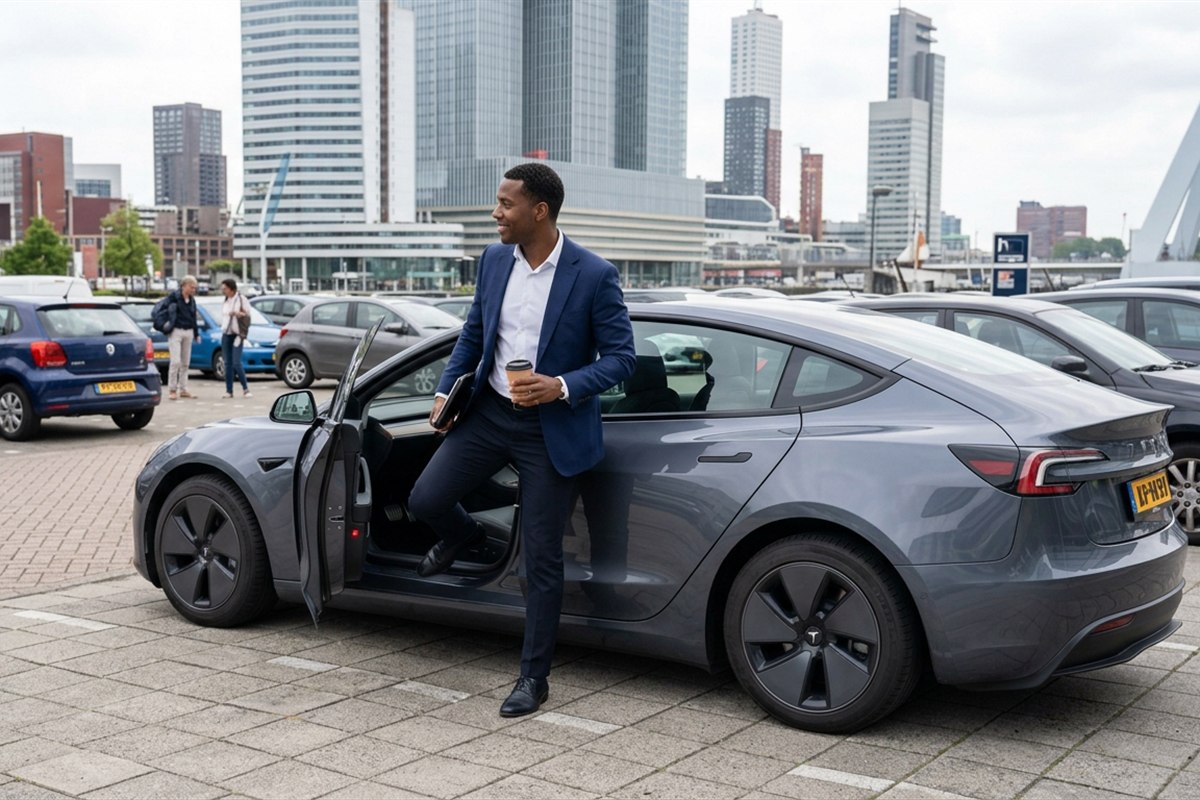
Your pool cars can be shared too.
Pool cars without a regular driver are just as easy to book and log via Klicq, with real-time availability, and every use is recorded: pick-up, return and the odometer readings.
- Business use only. The pool car is shared for business trips; private use is not possible in the platform. The costs go to the right cost centre per trip.
- Keys: already sorted today. Pool car keys get a central place, for example a key safe at reception. For shared lease cars, the spare key is enough.
- Later, the digital key (CCC). Opening the car with your phone, as soon as it is available.
- Always clear who drove when. Day-accurate records per trip and per driver, for cost allocation and your own tax accounting.
Three options for your sharing policy.
For private use, your organisation chooses a policy. You decide what the borrowing colleague pays and what you give away, and you can adjust this every year. Klicq sets up the policy with you and then runs it automatically.
-
Unlimited driving
The borrower only pays the taxable benefit and is never charged for mileage, whatever the distance. The most generous employment benefit: you give the mileage away entirely.
No mileage costs
-
Free allowance plus excess rate
You give employees a fixed number of free private kilometres per period, including fuel or charging. Above that allowance, the excess rate per kilometre for the car in question applies.
Free kilometres per period
-
Price per kilometre
The borrower pays an all-in price for every private kilometre driven, including fuel or charging, with no free allowance. You save directly on claims and hire cars.
Pay per kilometre
Always applies, whatever you choose.
For private use, the borrower always pays the taxable benefit, calculated on the list price. Your sharing policy only determines whether and how the kilometres on top are charged.
A business trip is always unlimited and free of mileage costs. We set the exact amounts together with you during set-up.
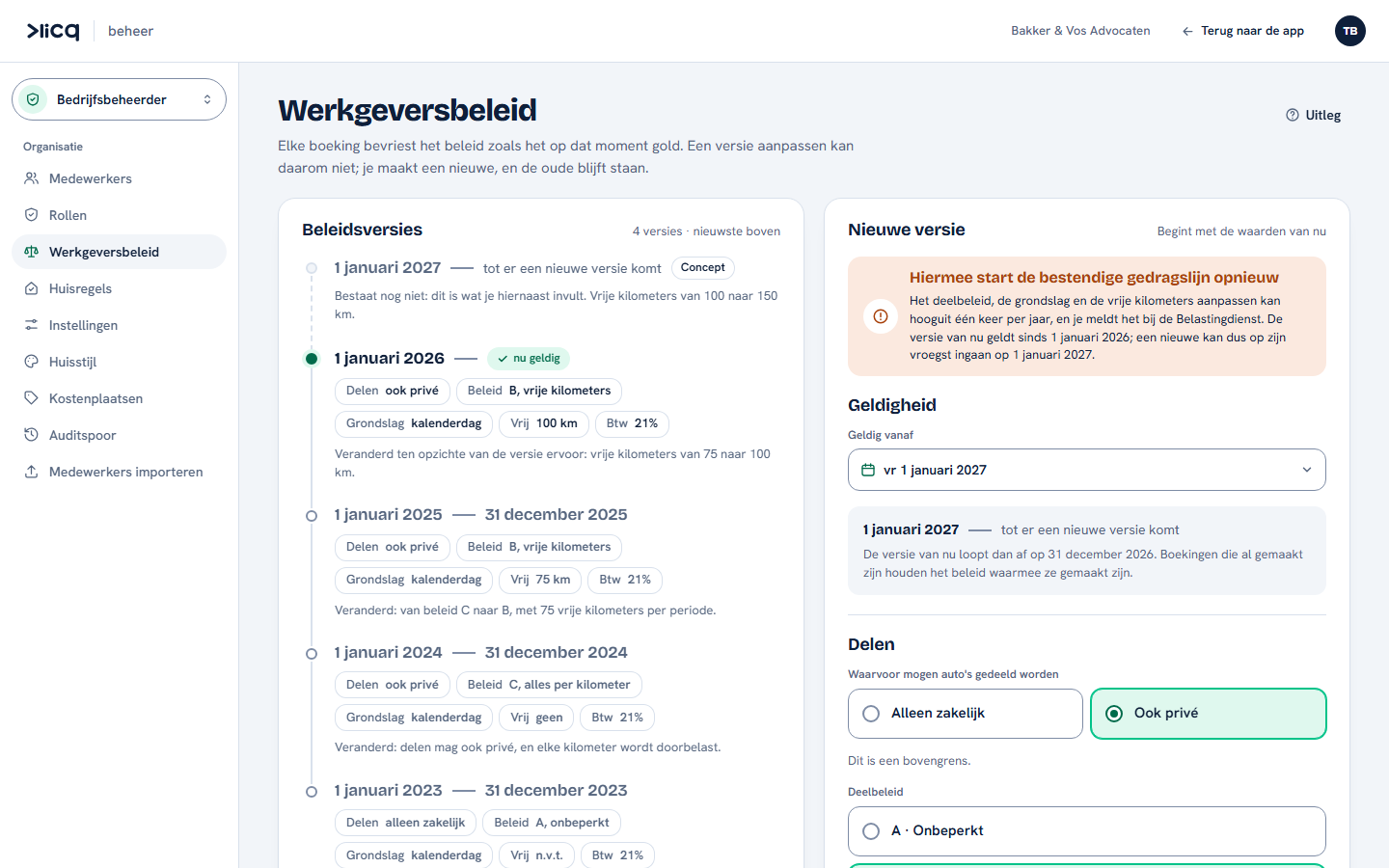
What is benefit shifting?
Shifting (part of) the lease driver's taxable benefit to a colleague for tax purposes, at the moment that colleague uses the lease car privately.
The lease driver then pays the taxable benefit in proportion to their own private use; for the days a colleague uses the car privately, the taxable benefit falls to that colleague. The condition is that private use is correctly recorded per user and processed for tax, and that is exactly what Klicq does automatically.
Sharing is possible within the same tax entity (the same Chamber of Commerce number). That keeps the car's availability properly arranged for tax purposes.
Hanna Bakkercolleague without a lease car, she drove
This is how it appears on her payslip
Taxable benefit, car via Klicq · plus line€33.56
Saskia van Dijklease driver, the Polestar 2 is hers
This is how it appears on her payslip
Taxable benefit, car via Klicq · minus line−€33.56
- Grounded in law
- The taxable benefit is allocated on the basis of actual private use, in line with the principles of “making available”. It builds on existing tax legislation and is confirmed in case law, including rulings of the Dutch Supreme Court.
- In line with policy direction
- Policy direction supports shared use: a letter to the Dutch House of Representatives (May 2025) explicitly recognises the shared use of company cars.
- Risk minimised
- Klicq ensures the correct allocation per user and a flawless audit trail. The tax set-up has been externally reviewed by independent tax specialists, and arrangements can be put in writing with the Dutch Tax Administration.
Cars are already being shared. It is rarely arranged for tax.
A lease driver lends their car out for a weekend, a pool car goes home with someone. There is no ill will: colleagues help each other. But the Dutch Tax Administration does not assess intentions, only what can be proven. And the burden of proof lies with you as the employer.
-
A lease driver lends their car to a colleague for a weekend
- What happens for tax
- The colleague has the car at their disposal. The lease driver pays the taxable benefit, the colleague does not, even though they drive it privately.
- Where the evidence is missing
- Afterwards nobody knows who drove when; the lease driver's taxable benefit does not cover the colleague.
-
The pool car goes home in the evening
- What happens for tax
- Commuting in a pool car is not allowed. The car is parked outside the colleague's home outside working hours; they can use it privately.
- Where the evidence is missing
- No record of who had the car, for how long, and whether it was used privately.
-
The pool car is used privately “just briefly”, for a house move or a weekend
- What happens for tax
- For one day of use, the private limit is 1.4 kilometres; it is exceeded straight away.
- Where the evidence is missing
- Nothing recorded, so you cannot apply the 500-kilometre test.
-
The trip log is filled in afterwards, or missing for the pool car
- What happens for tax
- The log has no evidential value; the Tax Administration checks it against fuel receipts, MOT (APK) readings and traffic fines.
- Where the evidence is missing
- With a pool car, nobody feels responsible for the records.
With shared use, the private limit of 500 kilometres a year is pro-rated: for one month of use it is 42.5 kilometres, for one day 1.4 kilometres.
Sharing is allowed, via Klicq.
Every time a company car is shared, lent out or swapped, it goes through the platform and is recorded. Not as extra admin, but as the way colleagues arrange a car between them. You can make using Klicq a condition: lending or swapping is allowed, but only via the platform. That creates the “real control” the courts ask for.
- Every shared use recorded. Pick-up and return, the odometer readings, business or private, and for a business trip the destination.
- Informal arrangements too. With a direct request, a colleague asks the lease driver for the car, even if it was not “officially” available.
- The taxable benefit with the right person. For every day it is known who had which car, so no surprises afterwards for the lease driver who lent it out.
- Evidence for five years, in one place. In a tax audit, an overview per car and per employee, not a reconstruction from calendars and fuel receipts.
What Klicq does not do: the platform does not replace a per-kilometre trip log, nor tax advice. A lease driver's own trips in their own car fall outside Klicq; they stay in their normal trip log. Together with that trip log, or a genuine ban on private use, Klicq provides the evidence for shared use.
What it can cost.
If you cannot complete the evidence, an additional payroll tax assessment follows, going back up to five years. The employer receives that assessment, because it is the party obliged to withhold tax.
If the Tax Administration imposes the additional assessment as a final levy, you cannot recover it from the employee. And on top of payroll tax, a VAT correction for private use follows, for which commuting does count as private.
| Item | Per year | Over five years |
|---|---|---|
| Taxable benefit22% of €45,000 | €9.900 | €49.500 |
| Default penalty or offence penalty10% of the additional assessment, or 25% to 50% for gross negligence or intent | €970 to €4,850 | €4,850 to €24,250 |
The figures in the table are an indication; the exact outcome depends on the rate, whether the employer can recover the assessment and whether the inspector opts for a final levy.
And it really does happen. The Dutch Tax Administration actively checks private use of cars: in its own sample over 2022 and 2023, it was the cause in 17% of businesses with a correction to income tax, and trip logs proved “often incomplete, drawn up afterwards or inconsistent”. The courts generally uphold those assessments. A home care organisation, for example, received an additional assessment over five years, with an offence penalty, despite a written ban on private use with a €250 fine per breach (Dutch Supreme Court, 2017).
The pattern in case law.
In almost every case there was a scheme, a ban or good intentions: a written ban with a fine per breach, a GPS system, a rental scheme for private use. What was missing was proof that the scheme worked in practice: who had the car, when, for what, and who checked it. Then the inspector wins. With shared use, those questions can only be answered if it is recorded at the time.
Tax risks of shared cars and pool cars
From a click in the app to a journal entry.
One automated data flow, watertight for audits and the Tax Administration. No forms, no manual claims, no shadow administration.
-
Click in the app
An employee books and drives. The platform records, fit for the tax authorities, who drove, when and how many kilometres.
-
Taxable benefit value
Klicq translates actual use, to the day, into the correct taxable benefit and personal contribution per employee, including for payroll tax.
-
Payroll
Changes go to your payroll package through an integration or a validated export, suitable for the most widely used HR and payroll packages. Manual processing is also possible.
-
Journal entry and audit
Automatic synchronisation with your accounts, with an audit trail and sample calculations for tax accountability.
Our expectation: Klicq always pays for itself.
Against the platform costs stand savings you can see in euros, benefits that cannot be captured in euros, and a sharing policy with which you decide what sharing costs.
In euros.
-
Tax risk covered
Without consistent records, an additional assessment, a fine and interest follow per pool car. Via Klicq, every shared use is recorded. How it adds up
up to €10,000per car per year
-
Fewer pool cars needed
Colleagues see which car is available and book it. That way every pool car is better used, and you need fewer of them.
€7.000 – 9.000per car saved per year, all-in lease rate
-
Fewer claims and less handling
No mileage claims afterwards. The payroll changes come through an export.
€10 – 15in admin, per claim avoided
-
Cheaper business mileage
A lease car that would otherwise stand idle replaces the private car with a mileage allowance, or the hire car, for a business trip. Like Sanne, who takes the office car to a client.
No claim, no hire car
Orders of magnitude, indicative. What it means for your organisation depends on your fleet; in a demo we use that as the starting point.
Beyond euros.
- An employment benefit for those without a lease car. Colleagues without a lease car get affordable private mobility. That counts as an employment benefit, and helps you keep good people.
- Fewer hours of fleet management. Booking, logging and settling run automatically. That saves the fleet manager hours every month.
- Insight into who drives what. Utilisation, odometer readings and the taxable benefit per person, in one overview. And input for your CO₂ reporting.
- Peace of mind, because the tax side is sorted. Every shared use is recorded, with an audit trail for the Tax Administration. Nobody has to reconstruct anything afterwards.
Your policy, your return.
With a free allowance plus excess rate, and with a price per kilometre, the borrower pays for their private kilometres. That way you decide what sharing costs you, and more shared kilometres help cover the cost of the fleet. If you choose unlimited driving, you give the kilometres away: the most generous employment benefit, and that too is a choice with value. The three options
 Bas, 3 weeks on holidaylease driver, shares his Volvo EX30
Three colleagues use his EX30 while he is away: 1,101 km of private driving in 8 days.
- all-in cost for colleagues
- +€229*
- net revenue for the employer
- +€64*
Worked example. Amounts marked * depend on your sharing policy.
What Klicq costs.
One monthly subscription: a fixed amount based on the size of your fleet, and a small contribution per employee for support. For that, you use Klicq without limits, with the whole fleet and all employees.
Prices as of September 2026, excluding VAT.
| Fleet | Per month |
|---|---|
| up to 25 cars | €249 |
| 26 – 50 cars | €399 |
| 51 – 100 cars | €649 |
| 101 – 250 cars | €1.049 |
| 251 cars or more | tailored |
| Employees | Per employee per month |
|---|---|
| 1 – 100 | €0.75 |
| 101 – 500 | €0.50 |
| 501 or more | €0.30 |
An example: 40 cars and 120 employees.
- Platform, 26 – 50 cars
- €399
- Support, 100 × €0.75 and 20 × €0.50
- €85
- Per month, excluding VAT
- €484
Unlimited use, for the whole fleet and all employees.
On top of the subscription.
- Onboarding, one-off
- €500 if you set it up yourself, €1.500 guided, with payroll integration and training. Tailored above 250 cars.
- Modules
- Future features, such as extended AI-guided damage recording and the digital key, will most likely be charged per use, for clients who want to use them.
- Contract
- An annual contract, invoiced monthly and indexed yearly. Pay annually and you get a 10% discount. We review the fleet and the number of employees every year.
What does it cost for your fleet?
In a demo we calculate it for your fleet: the subscription, the support contribution and what sharing is expected to deliver.
The questions management, HR and Finance ask.
Answered honestly, before the first car is shared.
63%
of employees are willing to take part in car sharing if it lowers their taxable benefit or personal contribution.
Source: Verian 2024, n=1,242
- Will this cost us money?
- Our expectation is that Klicq always pays for itself, with lower fleet costs and more mobility from the same fleet. How, see above. You will find the prices under Pricing.
- Is it all right from a tax point of view?
- Yes. Benefit shifting is grounded in law and confirmed in case law. The set-up has been externally reviewed, and Klicq ensures correct processing, with an audit trail for the Tax Administration.
- And what about the organisation?
- All administrative flows are automated, and if you wish your teams are trained through the Klicq Academy. Your people do not need to become tax specialists.
- HR: how do I explain it?
- You get ready-made communication: explanatory material, an FAQ and an introduction session by Klicq. The Klicq Academy handles follow-up questions. Sharing is the employee's choice, within the policy you set; incentives make taking part attractive, and making it compulsory is usually unnecessary.
- Finance: insurance and liability?
- Insurance and liability with multiple drivers are checked against the policy conditions in advance. Every trip is linked to a driver, so it is always clear who drove when.
Curious what Klicq delivers for your organisation?
Schedule a no-obligation demo or request the white paper. Above 250 cars, we tailor the rates: info@klicq.nl.
Fleet manager? Read what Klicq takes off your hands